You’ve heard it your whole life. “The weather was dreadful.” “She gave a dreadful performance.” “What a dreadful waste.” But here’s the thing when most people use the word dreadful, they’re only using one of its three distinct meanings.
The word has an older, darker soul than most people realize. It grew from the language of dread genuine, deep fear and for centuries it described things that caused terror, not just inconvenience. That original weight still lives inside the word, even when you use it to describe a bad cup of coffee.
This guide breaks down all three meanings, gives you 10 real examples that show the word in action, and explains exactly when to use each one.
Quick answer
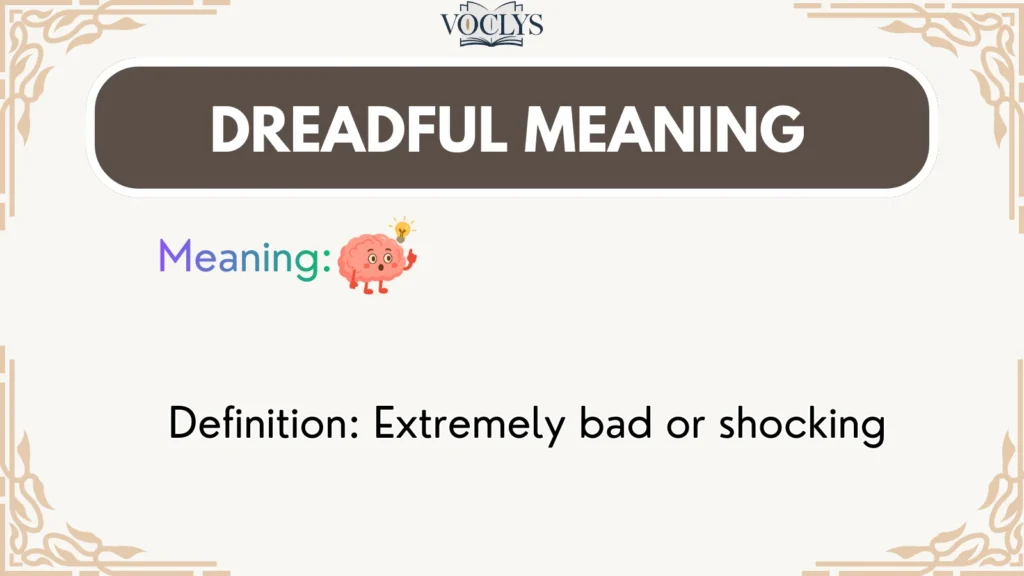
Dreadful is an adjective with three meanings: (1) causing great fear or horror — a dreadful storm; (2) extremely bad or unpleasant in quality — a dreadful performance; (3) used as an intensifier to emphasize something bad — a dreadful mess. It comes from the Old English word dread, meaning deep fear or anxiety.
The 3 distinct meanings of dreadful
Most dictionaries list dreadful as simply meaning “very bad.” That is accurate but incomplete. Here are all three meanings, each with its own character.
Meaning 1
Causing great fear, horror, or dread
This is the original meaning — the one the word was built from. When something is dreadful in this sense, it inspires genuine terror, horror, or deep anxiety. It goes beyond “unpleasant” into genuinely frightening or devastating territory.
“They heard a dreadful scream coming from the old house at the end of the street.”
Meaning 2
Extremely bad, poor in quality, or unpleasant
This is the most common modern use. Something dreadful in this sense is simply very bad — a poor performance, a painful experience, unpleasant weather, or an embarrassing mistake. The fear element has faded; only the severity remains.
“The food at that restaurant was absolutely dreadful — cold, tasteless, and overpriced.”
Meaning 3
Used as an intensifier for something bad
Dreadful can function like the words awful or terrible — as an emphasiser that adds weight to whatever follows. In this use it doesn’t describe a separate quality; it just amplifies the degree of something bad. This is especially common in British English.
“She was in a dreadful hurry and couldn’t stop to talk.”
Quick tip: A good way to test which meaning applies — ask yourself: does the thing described cause fear (meaning 1), is it simply very bad (meaning 2), or is “dreadful” just adding emphasis (meaning 3)? In most modern everyday conversation, you’ll be using meaning 2.
10 examples of dreadful used in a sentence
The best way to understand a word is to see it working in real context. Here are ten examples across different settings — daily life, literature, news, sport, and conversation — showing exactly how dreadful is used.
10 real example sentences
- “The traffic was absolutely dreadful this morning — it took me two hours to travel ten miles.”
→ Meaning 2: extremely bad and unpleasant. - “Movistar’s team leader Enric Mas also had a dreadful day on the mountain stage.”
→ Meaning 2: very poor performance. (New York Times, May 2026) - “She woke up at 3 AM to a dreadful noise — something heavy crashing against the walls downstairs.”
→ Meaning 1: frightening, causing genuine alarm. - “What a dreadful waste of talent — he could have been one of the best players of his generation.”
→ Meaning 3: intensifier emphasising the severity of the waste. - “Aunt Em will surely think something dreadful has happened to me.”
→ Meaning 1: something horrifying or catastrophic. (L. Frank Baum, The Wonderful Wizard of Oz, 1900) - “The reviews were dreadful — critics called it the worst film of the decade.”
→ Meaning 2: extremely poor quality. - “I feel absolutely dreadful — my throat hurts, I have a fever, and I can barely get out of bed.”
→ Meaning 2: very unwell and miserable. - “Doctors can feel a dreadful sense of personal failure when they lose a patient they fought hard to save.”
→ Meaning 1/2 overlap: a deep, painful emotional experience. (Sunday Times) - “Those children have dreadful manners — they interrupted every adult in the room.”
→ Meaning 2: very poor, embarrassingly bad. - “After a dreadful performance in the opening 45 minutes, they upped their game after the break.”
→ Meaning 2: very poor quality performance. (BBC Sport)
Notice the pattern: in most modern uses, dreadful is interchangeable with terrible or awful. The difference is one of tone — dreadful carries slightly more gravity and formality than awful, and it sounds more British English than American English in casual conversation.
Where does the word dreadful come from?
Dreadful is built from two Old English parts: dread + -ful.
Dread comes from Middle English dreden, meaning to be in great fear. The suffix -ful in Old English means “full of” or “characterised by.” So the original meaning of dreadful was literally “full of dread” — something so frightening it fills you with deep fear.
The earliest recorded use in English is from around 1225, in the Ancrene Riwle — a guide for anchoresses (religious women living in isolation). Back then, the word described things that caused genuine terror, not just inconvenience.
Over the following centuries, like many strong English words (terrible, awful, horrible), it gradually softened through overuse. By the 1800s it was already being used to mean simply “very bad.” Today the original fearful meaning survives mainly in formal, literary, or dramatic contexts — while the everyday meaning refers to anything that falls far short of acceptable.
Interesting fact: In Victorian England, cheap illustrated books featuring violent or sensational stories were called penny dreadfuls — named because they cost one penny and were considered dreadful (scandalous, shockingly bad) by respectable society. They were the tabloids of the 1800s.
Synonyms and antonyms of dreadful
| Synonyms (words with similar meaning) | Antonyms (words with opposite meaning) |
|---|---|
| Terrible | Wonderful |
| Awful | Excellent |
| Horrific | Delightful |
| Appalling | Magnificent |
| Atrocious | Splendid |
| Abysmal | Superb |
| Frightful | Glorious |
| Horrendous | Pleasant |
Among the synonyms, the subtle differences matter in writing. Terrible and awful are the closest matches in everyday use. Appalling and atrocious carry a stronger sense of moral outrage. Horrific and horrendous lean toward physical horror. Abysmal usually refers to quality. Dreadful sits somewhere in the middle — versatile, formal, and slightly dramatic.
What does “dreadfully” mean?
Dreadfully is the adverb form of dreadful. It means “in a dreadful manner” or is used as an intensifier meaning “extremely” or “very much.”
- “He was dreadfully lonely after moving to the new city.” — extremely lonely.
- “She behaved dreadfully at the dinner — interrupting everyone and ignoring the host.” — in a very bad way.
- “I miss him dreadfully.” — very much, intensely. (British English)
- “The performance was dreadfully dull.” — extremely dull; dreadfully emphasises the degree.
In British English, “dreadfully sorry” is a polite, slightly formal expression used to apologise — meaning “very sorry indeed.” It sounds natural and genuine without being overly casual.
When to use dreadful — and when not to
Dreadful is a powerful word — it communicates real severity. Overusing it weakens it. Here’s how to use it well.
Use dreadful when:
- You want to convey something was genuinely bad, not just mildly disappointing.
- You want to sound slightly formal or British in register.
- You want more emotional weight than “bad” or “poor” provides.
- You are describing a frightening or deeply upsetting event (meaning 1).
Avoid dreadful when:
- The situation is only mildly bad — dreadful will sound overdramatic.
- You need a positive emphasis — dreadful is almost never used in a positive context.
- You are writing in American casual English where awful or terrible sound more natural.
Frequently asked questions about dreadful
What is the meaning of dreadful in simple words?
In simple words, dreadful means extremely bad or unpleasant. It can also mean something that causes fear or horror. For example, “The weather was dreadful” means the weather was very bad. “A dreadful scream” means a frightening, terrifying scream.
Is dreadful stronger than terrible?
They are very close in strength, but dreadful carries a slightly more formal and dramatic tone than terrible. Terrible is more neutral and widely used in American English. Dreadful sounds slightly more British and literary. Both describe something very bad — the difference is mainly one of style and emphasis.
What does it mean when someone says “I feel dreadful”?
When someone says “I feel dreadful,” they usually mean they feel very unwell — physically ill, exhausted, or extremely bad. It can also mean they feel intense guilt or remorse about something they did. “I feel dreadful about what I said to her” means they feel very sorry and guilty.
What is a penny dreadful?
A penny dreadful was a type of cheap, popular publication in Victorian Britain (roughly 1830s–1900s) that featured sensational stories of crime, violence, and adventure. They cost one penny and were considered shocking or “dreadful” by polite society. They were the forerunners of pulp fiction and modern tabloids — and hugely popular among working-class readers.
Can dreadful be used in a positive way?
Almost never in modern English. Unlike words such as sick or wicked which have developed positive slang meanings, dreadful has stayed firmly negative. The closest exception is the old literary use meaning “inspiring awe and reverence” (as in “the dreadful presence of God”), but this meaning is now considered archaic and would not be understood in everyday conversation.
What is the difference between dreadful and dreadfully?
Dreadful is an adjective — it describes a noun. “A dreadful mistake.” Dreadfully is an adverb — it modifies a verb or adjective. “He performed dreadfully.” “She was dreadfully nervous.” Both come from the same root; the adverb simply shows how something was done or how extreme it was.
How do you pronounce dreadful?
Dreadful is pronounced DRED-ful — two syllables. The first syllable rhymes with bed or red. The second syllable is a soft -ful, like the end of careful or harmful. Audio: /ˈdrɛd.fəl/.
Summary: what dreadful really means
Dreadful is one of those English words that has lived many lives. It started as a genuine word for terror and horror rooted in the Old English concept of dread, the kind of deep fear that keeps you awake at night. Over centuries of everyday use it softened, and today it most commonly means simply “very bad.”
But that original weight never fully disappeared. When you call something dreadful, you’re drawing on 800 years of language — a word that once described things people were genuinely afraid of, now applied to bad weather, poor performances, and cold soup.
That contrast is exactly what makes it useful: dreadful sounds stronger than “bad” but more measured than “horrific.” It occupies a particular emotional middle ground — serious without being melodramatic, formal without being stiff — that makes it one of the most versatile negative adjectives in English.

Hi, I’m Jeson, the creator and author behind Voclys. I started this platform with a simple goal — to make word meanings, vocabulary learning, and English understanding easier for everyone.
Language has always inspired me. I believe that the right words can change how we think, communicate, and express ourselves. That’s why I created Voclys — so learners, students, and readers can find clear, simple, and reliable meanings in one place.
Here, I focus on writing content that is:
✔ Easy to understand
✔ Helpful for real-life use
✔ Simple, clean, and meaningful
Whether you’re improving your English, searching for a word meaning, or just curious about language — I’m happy you’re here. My aim is to help you grow your vocabulary step-by-step and feel more confident with words.
Thanks for being a part of Voclys —
where every word finds its meaning.
— Jeson