Understanding words that appear in texts or online chats can prevent confusion. One word people often want to know about is Degree Meaning. You may see it in conversations, social posts, or even gaming chat, and wonder what someone really means. Learning Degree Meaning helps you understand messages clearly and respond confidently. This guide explains everything in a simple, friendly way so you can use it naturally in daily conversations.
What Does Degree Meaning Mean (Definition and Origin)
The term degree can have multiple meanings depending on the context. When people look for Degree Meaning, they usually want to understand one of the following:
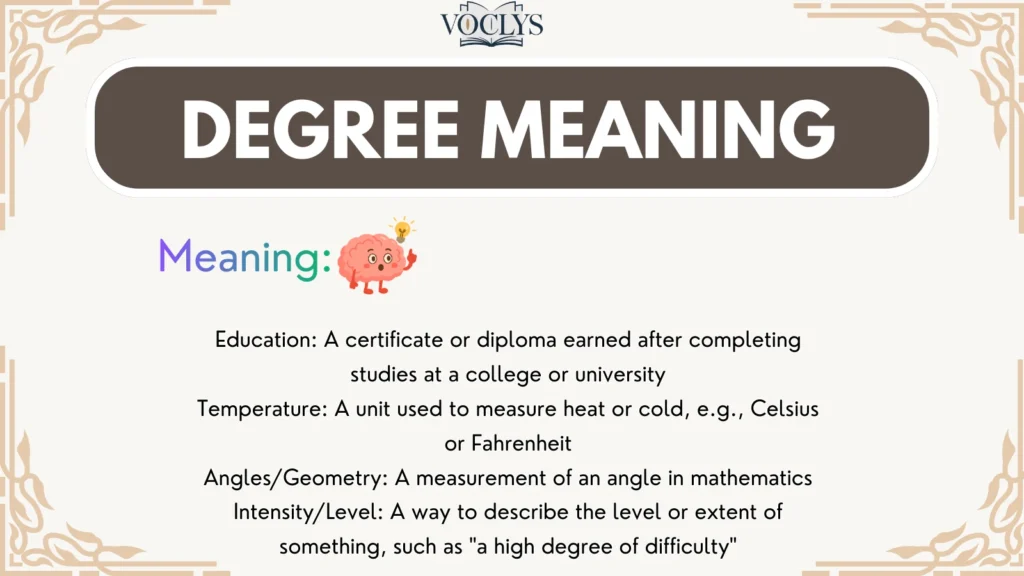
- Education: A certificate or diploma earned after completing studies at a college or university
- Temperature: A unit used to measure heat or cold, e.g., Celsius or Fahrenheit
- Angles/Geometry: A measurement of an angle in mathematics
- Intensity/Level: A way to describe the level or extent of something, such as “a high degree of difficulty”
- Rank/Position: Used to indicate status, rank, or level in certain fields
The origin of the word degree comes from the Latin gradus, meaning step or stage, which explains why it often indicates level or rank.
Why Degree Meaning Matters in Daily Life
Understanding Degree Meaning is important because the word appears in many contexts:
- Conversations about school, education, or careers
- Weather reports and temperature discussions
- Math, geometry, and science problems
- Descriptions of intensity or levels of performance
Knowing which type of degree someone is referring to helps you respond accurately and avoid misunderstandings.
How to Use Degree in Different Contexts
1. Education Degree
Use degree to refer to diplomas or academic achievements.
Examples:
- She earned her bachelor’s degree in biology
- He is pursuing a master’s degree in computer science
- Getting a college degree can open more career opportunities
2. Temperature Degree
Use degree to describe heat or cold.
Examples:
- It is 30 degrees Celsius outside today
- Water freezes at 0 degrees Celsius
- The oven should be set to 180 degrees
3. Angle or Geometry Degree
Use degree in math or science contexts.
Examples:
- A right angle measures 90 degrees
- Rotate the shape by 45 degrees clockwise
- The triangle has angles of 60, 60, and 60 degrees
4. Intensity or Level Degree
Use degree to describe how strong or significant something is.
Examples:
- She showed a high degree of skill
- The problem requires a certain degree of patience
- There is a low degree of risk involved
5. Rank or Position Degree
Use degree when talking about levels in hierarchy or ranking.
Examples:
- He reached a high degree in the organization
- This ceremony marks the final degree in their training
- The monk attained the highest degree of wisdom
Examples of Degree Meaning in Conversations
Chat Example 1
A: I just finished my degree
B: Congrats! What subject?
Chat Example 2
A: What is the temperature outside?
B: It’s 25 degrees
Chat Example 3
A: Rotate the piece by 90 degrees
B: Got it
- Chat Example 4
- A: That was done with a high degree of care
- B: I noticed, it was perfect
Chat Example 5
A: He received the highest degree in his organization
B: That’s impressive
Common Mistakes or Misunderstandings
- Confusing types of degree: Always check if the conversation is about education, temperature, angles, or intensity
- Incorrect plural usage: Always say degrees for temperature or angles, but degree for a single academic achievement
- Mixing formal and informal: Avoid using degree for jokes in serious academic or professional contexts
- Assuming one meaning: Context is key; the same word can refer to multiple things
Related Words or Phrases
Other terms you might see alongside degree include:
- Diploma
- Certificate
- Celsius/Fahrenheit
- Angle/Rotation
- Rank/Level
These help clarify which degree is being referred to.
Tips for Using Degree Naturally
- Match the meaning to the context
- Use proper units for temperature or angles
- Be specific in academic or professional contexts
- Use degree of to describe intensity or quality
Recent Usage of Degree in Everyday Life
You will often see degree in:
- Education discussions (college or university degrees)
- Weather apps and forecasts
- Online math or geometry lessons
- Descriptions of skill, effort, or risk
- Organizational rank or hierarchy
FAQs:
What does degree mean in education?
It refers to an academic qualification earned after completing studies at a college or university
What does degree mean in temperature?
It is a unit used to measure heat or cold, like Celsius or Fahrenheit
What does degree mean in math or geometry?
It is a measurement of an angle, with a full circle equal to 360 degrees
Can degree describe intensity or level?
Yes it can indicate how strong or significant something is, like a high degree of skill or patience
Is degree the same as diploma?
Not exactly. A degree is the qualification earned, while a diploma can be a certificate or document showing completion of a course
Conclusion
Degree Meaning depends on the context. It can refer to an educational qualification, a temperature measurement, an angle, intensity, or rank. Understanding the context helps you communicate accurately and avoid misunderstandings. Whether you are discussing school, weather, math, or skill levels, knowing Degree Meaning gives you confidence in conversations.
Use degree carefully to match the situation, and it will make your messages clearer and more precise.
Share your favorite context for using degree in the comments and join the conversation!

Hi, I’m Malik, the creator and author behind Voclys. I started this platform with a simple goal — to make word meanings, vocabulary learning, and English understanding easier for everyone.
Language has always inspired me. I believe that the right words can change how we think, communicate, and express ourselves. That’s why I created Voclys — so learners, students, and readers can find clear, simple, and reliable meanings in one place.
Here, I focus on writing content that is:
✔ Easy to understand
✔ Helpful for real-life use
✔ Simple, clean, and meaningful
Whether you’re improving your English, searching for a word meaning, or just curious about language — I’m happy you’re here. My aim is to help you grow your vocabulary step-by-step and feel more confident with words.
Thanks for being a part of Voclys —
where every word finds its meaning.
— Malik