If you have ever studied English grammar or tried to improve your writing skills you have probably come across the term Infinitive Meaning. At first it may sound technical or confusing. But once you understand it the concept is actually very simple and extremely useful. Knowing the Infinitive Meaning helps you build clearer sentences speak more naturally and avoid common grammar mistakes.
This complete guide explains everything in easy language with real examples so you can understand and use infinitives confidently in daily communication.
What Does Infinitive Meaning Mean (Definition and Origin)
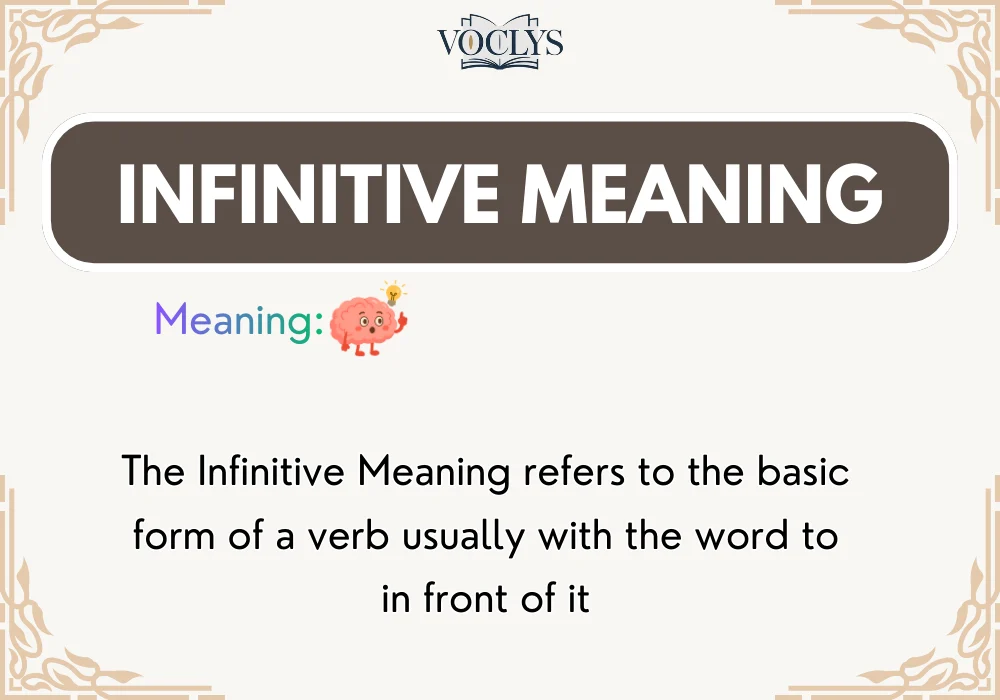
The Infinitive Meaning refers to the basic form of a verb usually with the word to in front of it.
Examples of infinitives:
- to eat
- to run
- to study
- to sleep
- to learn
In grammar the infinitive is the pure form of a verb before it changes for tense person or number.
For example:
- I eat
- She eats
- They ate
But the infinitive form stays the same:
- to eat
The word infinitive comes from Latin and means unlimited. That is because it is not limited by tense or subject.
So when someone asks about Infinitive Meaning they are asking about the base form of a verb and how it functions in a sentence.
Why Understanding Infinitive Meaning Is Important
Understanding Infinitive Meaning helps you:
- Form correct sentences
- Express purpose clearly
- Improve speaking and writing skills
- Avoid grammar confusion
Infinitives are extremely common in English. You use them every day often without realizing it.
For example:
- I want to learn
- She needs to rest
- They decided to leave
If you remove the infinitive the sentence feels incomplete.
Types of Infinitives
1. Full Infinitive
This is the most common form and includes the word to.
Examples:
- to read
- to play
- to understand
Sentence examples:
- I like to read
- She wants to travel
- We plan to start tomorrow
2. Bare Infinitive
This is the verb without to. It is used after certain verbs like can must should and let.
Examples:
- I can swim
- She must go
- Let him speak
In these cases the infinitive does not need to.
How to Use Infinitives in Sentences
Infinitives can function in different ways.
1. As a noun
An infinitive can act like a noun.
Example:
- To learn is important
- To forgive takes strength
Here the infinitive works as the subject of the sentence.
2. To show purpose
This is one of the most common uses.
Example:
- I study to improve my grades
- She exercises to stay healthy
- They left early to avoid traffic
In these examples the infinitive explains why something is done.
3. As an adjective
Example:
- I have a book to read
- She has work to finish
The infinitive describes the noun.
4. As an adverb
Example:
- He was happy to see her
- She was surprised to hear the news
It explains feelings or reactions.
Examples of Infinitive Meaning in Conversations
Conversation Example 1
A: Why are you saving money
B: To buy a new phone
Conversation Example 2
A: What do you want to do
B: I want to travel
Conversation Example 3
A: Why did she leave early
B: To catch the train
Notice how the infinitive explains purpose clearly.
Common Mistakes with Infinitives
1. Forgetting to after certain verbs
Incorrect
- I want learn English
Correct
- I want to learn English
2. Adding to where it is not needed
Incorrect
- I can to swim
Correct
- I can swim
3. Splitting infinitives incorrectly in formal writing
A split infinitive happens when a word comes between to and the verb.
Example
- To quickly finish
While this is common in modern English it may be avoided in very formal writing.
Related Grammar Concepts
To fully understand Infinitive Meaning it helps to know these related terms:
- Gerund which ends in ing like swimming or reading
- Base verb form
- Modal verbs like can should must
- Verb tense
Understanding these makes grammar much easier.
How to Decide When to Use an Infinitive
Ask yourself these questions:
- Am I showing purpose
- Am I following a verb like want need decide plan
- Am I using a modal verb
If yes you likely need an infinitive.
Personal Insight On Infinitive Meaning
Many learners feel confused at first but once you notice how often infinitives appear they become easy. You probably use them daily without thinking. Sentences like I want to eat or I need to sleep feel natural because infinitives are built into everyday speech.
Understanding Infinitive Meaning gives you more control over your language. It helps you write clearly and speak confidently.
Real Life Usage Examples
Here are everyday examples:
- I woke up early to exercise
- She studies hard to succeed
- They agreed to help
- He hopes to win
- We plan to move next year
All of these use infinitives naturally.
FAQs:
What is infinitive meaning in simple words?
It is the basic form of a verb usually with to in front of it like to run or to eat
Why is the infinitive important in English?
It helps show purpose intention and actions clearly in sentences
What is the difference between full and bare infinitive?
Full infinitive uses to like to go. Bare infinitive does not use to like can go
Can an infinitive act as a noun?
Yes it can act as a subject or object such as To learn is important
Do all infinitives use to?
No some verbs like can must and should use the bare infinitive without to
Conclusion
Understanding Infinitive Meaning is essential for clear and correct English. An infinitive is the base form of a verb often starting with to. It can act as a noun adjective or adverb and is commonly used to show purpose or intention.
Once you recognize how often infinitives appear in daily speech they become easy to use. Practice forming sentences with to plus a verb and you will quickly build confidence in grammar.
Share your favorite grammar topic in the comments and keep learning.

Hi, I’m Alex, a content writer and language enthusiast here at Voclys. I love exploring words, meanings, and the way language shapes how we think and communicate. That passion is what inspired me to start sharing clear and simple word explanations with learners around the world.
Through Voclys, my goal is to make vocabulary learning easier, more enjoyable, and stress-free. I focus on breaking down word meanings in a way that anyone can understand — whether you’re a student, English learner, or just curious about language.
I truly believe that strong vocabulary leads to confident expression, and I’m excited to help you grow step-by-step on your learning journey.
Thanks for visiting Voclys — and I hope the words you learn here make a real difference in your daily life.
— Alex