Have you ever heard someone say they were ordered to pay restitution and wondered what that really means? The term may sound formal or legal but the idea behind it is actually simple. Understanding Restitution Meaning helps you make sense of news reports court cases financial disputes and even everyday conversations about fairness and responsibility.
In this guide you will learn the clear definition of restitution how it is used in legal and non legal situations real life examples common misunderstandings and related terms. Everything is explained in plain language so you can fully understand and use the word correctly.
What Does Restitution Meaning Mean Definition and Origin
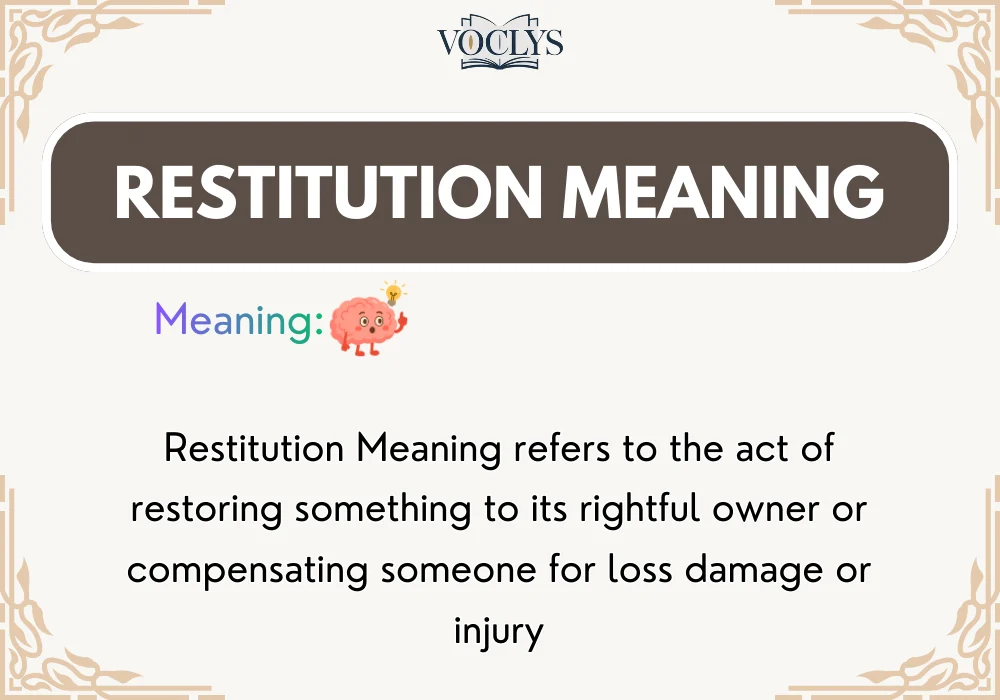
At its core Restitution Meaning refers to the act of restoring something to its rightful owner or compensating someone for loss damage or injury.
The word restitution comes from the Latin word restitutio which means restoration or giving back. The main idea is simple:
- Someone causes harm or loss
- They are required to fix it
- They return what was taken or pay for the damage
Restitution focuses on making things right rather than punishing someone. It is about restoring balance.
Restitution Meaning in Law
The most common place you will hear Restitution Meaning is in legal contexts.
In criminal law restitution means a court orders a person who committed a crime to compensate the victim for financial losses.
For example:
- If someone steals money they may be ordered to repay it
- If someone damages property they may have to cover repair costs
- If medical bills result from a crime the offender may have to pay them
Restitution is not the same as a fine. A fine is paid to the government. Restitution is paid directly to the victim.
Example in a Legal Sentence
The judge ordered the defendant to pay restitution for the stolen funds.
Here restitution means repayment to fix the harm done.
Restitution Meaning in Everyday Situations
Restitution is not only used in courtrooms. It can also describe everyday situations where someone makes up for a mistake.
Examples:
- A company refunds customers after selling a faulty product
- A friend replaces something they accidentally broke
- A business returns money after a billing error
In all these cases restitution means restoring what was lost or damaged.
How to Use Restitution in a Sentence
Here are practical examples to help you understand usage clearly.
Formal Usage
- The court required full restitution to the victim
- The company agreed to provide restitution for the losses
- Restitution was ordered as part of the settlement
Casual Usage
- He made restitution by paying for the repair
- She offered restitution after damaging the car
Notice that the word is often used in serious or formal discussions.
Examples of Restitution Meaning in Conversations
Conversation Example 1
A: What does restitution mean
B: It means paying someone back for harm or loss
Conversation Example 2
A: Why did the judge order restitution
B: Because the victim lost money due to the crime
Conversation Example 3
A: Is restitution the same as a fine
B: No a fine goes to the government. Restitution goes to the victim
These examples show how Restitution Meaning works in real discussion.
Common Mistakes or Misunderstandings
Understanding Restitution Meaning correctly helps avoid confusion. Here are common mistakes.
Confusing restitution with punishment
Restitution is about compensation not punishment. Jail time or fines are punishments. Restitution focuses on repairing harm.
Thinking restitution always involves money
Although it often involves financial payment it can also mean returning property or fixing damage.
Assuming restitution is optional
In legal cases court ordered restitution is mandatory. It is not a suggestion.
Confusing restitution with refund
A refund usually relates to a purchase. Restitution is broader and involves repairing harm or loss.
Difference Between Restitution and Compensation
People sometimes mix these terms.
- Restitution focuses on restoring what was lost
- Compensation can include payment for emotional distress pain or inconvenience
Restitution is usually tied to direct loss. Compensation may include additional damages.
Related Words and Concepts
Understanding related terms can deepen your knowledge.
- Reimbursement meaning paying someone back for expenses
- Compensation meaning payment for harm or suffering
- Damages meaning money awarded in civil court
- Refund meaning returning payment for a product or service
All of these connect to the idea of restoring fairness.
When Is Restitution Required
Restitution is commonly required in:
- Criminal court cases
- Civil lawsuits
- Consumer protection claims
- Financial fraud cases
- Property damage situations
In legal systems around the world restitution helps protect victims and ensure accountability.
Personal Insight on Restitution Meaning
The concept of restitution is powerful because it focuses on responsibility. Instead of only punishing wrongdoing it aims to repair the damage. In many situations this feels more fair and practical.
When people understand Restitution Meaning they see that justice is not just about penalties. It is also about restoring balance and helping victims recover.
Real Life Scenario
Imagine someone damages a neighbor’s fence while driving. Instead of only apologizing they pay for repairs. That payment is restitution. It fixes the harm.
Now imagine a company overcharges thousands of customers. After investigation the company returns the extra money. That is restitution too.
In both cases the goal is restoration.
FAQs:
What does restitution mean?
Restitution means restoring something to its rightful owner or paying for damage loss or injury
Is restitution the same as a fine?
No a fine is paid to the government. Restitution is paid directly to the victim
Can restitution include non monetary actions?
Yes it can involve returning property or repairing damage not only money
Is restitution used only in criminal cases?
No it can also appear in civil cases consumer issues and everyday disputes
Why is restitution important?
It helps restore fairness by ensuring victims are repaid for their losses
Conclusion
Understanding Restitution Meaning makes it easier to follow legal discussions financial news and serious conversations about fairness. At its core restitution is about restoring what was lost or damaged. Whether in a courtroom or daily life it focuses on repairing harm rather than simply punishing someone.
The next time you hear the word restitution you will know it refers to giving back paying back or making things right. That simple idea of restoration is what defines the term.
Share your favorite word meaning you would like explained next and join the conversation.

Hi, I’m Malik, the creator and author behind Voclys. I started this platform with a simple goal — to make word meanings, vocabulary learning, and English understanding easier for everyone.
Language has always inspired me. I believe that the right words can change how we think, communicate, and express ourselves. That’s why I created Voclys — so learners, students, and readers can find clear, simple, and reliable meanings in one place.
Here, I focus on writing content that is:
✔ Easy to understand
✔ Helpful for real-life use
✔ Simple, clean, and meaningful
Whether you’re improving your English, searching for a word meaning, or just curious about language — I’m happy you’re here. My aim is to help you grow your vocabulary step-by-step and feel more confident with words.
Thanks for being a part of Voclys —
where every word finds its meaning.
— Malik