In modern discussions about science, finance, and even casual chat online, you might come across the term stochastic. If you’ve ever wondered what Stochastic Meaning really is and how it is used, you’re in the right place. Understanding this word can help you follow conversations in statistics, gaming, AI, and even memes that throw around technical terms just for fun. This guide explains everything clearly and in a friendly way so you can use it confidently.
What Does Stochastic Meaning Mean (Definition and Origin)
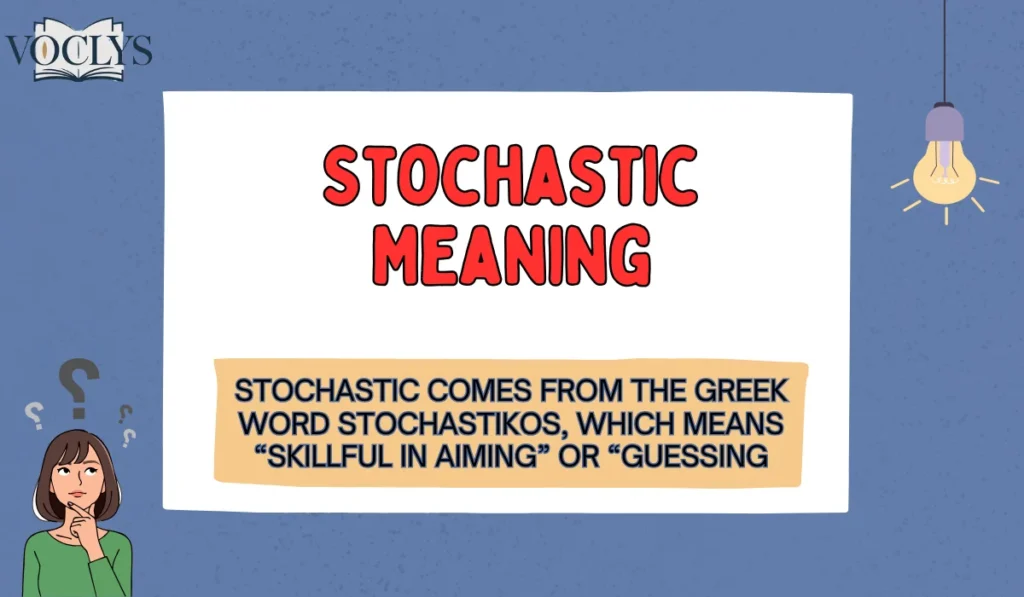
The term stochastic comes from the Greek word stochastikos, which means “skillful in aiming” or “guessing.” Today it is used in mathematics, statistics, finance, and science to describe processes that are random or probabilistic rather than deterministic.
In simple words: if something is stochastic, it involves some level of chance or unpredictability.
Examples of stochastic things include:
- Stock market fluctuations
- Rolling a dice
- Weather patterns
- Random events in computer simulations
The concept first appeared in probability theory and statistics but has since spread into everyday conversations in tech, data science, and even casual discussions about unpredictable events.
Why Stochastic Meaning Matters
Knowing stochastic can help you:
- Understand news about finance or stock markets
- Follow discussions in data science or AI
- Explain randomness in gaming, simulations, or experiments
- Sound knowledgeable when talking about unpredictable events
It’s more than just a technical term. Using stochastic correctly shows you understand how probability and chance influence outcomes.
How to Use Stochastic in Conversations
You can use stochastic in several contexts:
1. Scientific or mathematical context
- “The model uses stochastic processes to predict weather patterns.”
- “We analyzed the stochastic behavior of particle movement in the lab.”
2. Finance and trading
- “Stock prices are stochastic, so there’s always some risk.”
- “Traders use stochastic indicators to decide when to buy or sell.”
3. Casual or online chat
- “The game’s loot drops are stochastic, so you never know what you’ll get.”
- “Random events in this simulation are stochastic, making it more fun.”
Examples of Stochastic Meaning in Conversations
Example 1
A: What does stochastic mean in finance?
B: It means something is random or involves chance, like stock prices.
Example 2
A: Why is the weather prediction so unpredictable?
B: Because the system is stochastic; small changes can have big effects.
Example 3
A: This game feels unfair sometimes.
B: Yeah, it’s stochastic—random chance decides the outcome.
Common Mistakes or Misunderstandings
1. Thinking stochastic means completely random
While stochastic involves randomness, it often follows a probabilistic pattern or distribution. It’s not pure chaos.
2. Using it only in math
Although common in statistics, stochastic is also widely used in finance, computer simulations, and casual conversation about randomness.
3. Confusing stochastic with deterministic
Deterministic systems have predictable outcomes, while stochastic systems include an element of chance.
Related Terms and Concepts
If you like stochastic, you might encounter these related words:
- Random – completely unpredictable
- Probabilistic – based on probability
- Chaotic – sensitive to initial conditions, often unpredictable
- Monte Carlo simulation – a computational method using stochastic processes
Tips for Using Stochastic Naturally
- Use it when discussing chance or unpredictability
- Pair it with examples for clarity, like games, stocks, or experiments
- Avoid using it in casual chat if your audience doesn’t understand technical terms
- Think of it as “random but in a patterned or probabilistic way”
Recent Usage of Stochastic in Online Contexts
On social media and forums, you may see phrases like:
- “This game uses stochastic drops for loot”
- “AI simulations are stochastic, making predictions tricky”
- “Stock markets behave stochastically, so don’t panic”
It’s become a trendy word in tech discussions and data-driven posts.
FAQs:
What does stochastic mean?
It refers to systems or processes that involve randomness or chance rather than being fully predictable.
Is stochastic only used in math?
No, it is also used in finance, AI, gaming, and casual discussions about randomness.
Can I use stochastic in casual conversation?
Yes, especially when describing something unpredictable or random, but make sure your audience understands the term.
What is the difference between stochastic and random?
Random is general unpredictability, while stochastic usually refers to randomness that follows probabilistic rules or patterns.
Why is stochastic important in finance or AI?
It helps model real-world unpredictability and allows for better predictions and risk management.
Conclusion
Stochastic Meaning usually refers to something involving chance or probabilistic behavior. From statistics to gaming, finance, and AI, understanding stochastic helps you explain unpredictability and randomness with confidence.
Use stochastic when you want to describe systems that are partly random but may follow patterns. It’s a versatile word that makes your conversations sound smarter and more precise.
Have you encountered stochastic events in your life or games? Share your examples in the comments and join the discussion.

Hi, I’m Alex, a content writer and language enthusiast here at Voclys. I love exploring words, meanings, and the way language shapes how we think and communicate. That passion is what inspired me to start sharing clear and simple word explanations with learners around the world.
Through Voclys, my goal is to make vocabulary learning easier, more enjoyable, and stress-free. I focus on breaking down word meanings in a way that anyone can understand — whether you’re a student, English learner, or just curious about language.
I truly believe that strong vocabulary leads to confident expression, and I’m excited to help you grow step-by-step on your learning journey.
Thanks for visiting Voclys — and I hope the words you learn here make a real difference in your daily life.
— Alex