Understanding grammar terms helps you write and speak more clearly. One term that often confuses people is Superlative Meaning. You might hear it in school, see it in messages, or encounter it in online learning, and wonder what it really means. Knowing Superlative Meaning helps you describe things effectively and use comparisons correctly. This guide explains everything in a simple friendly way so you can understand it easily and use it naturally in writing or conversation.
What Does Superlative Meaning Mean (Definition and Origin)
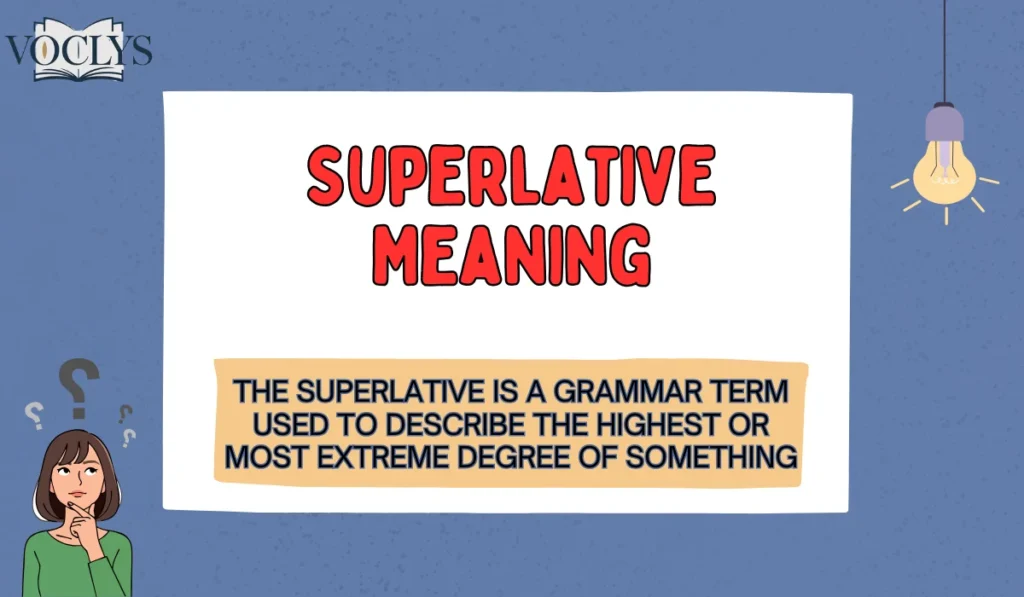
The superlative is a grammar term used to describe the highest or most extreme degree of something. It is a form of adjective or adverb that shows that something is at the top compared to others.
Examples of superlatives include:
- Tallest – He is the tallest in the class
- Fastest – She ran the fastest in the race
- Best – This is the best movie I have ever seen
The origin of superlatives comes from Latin where superlativus meant “highest degree.” Over time, it became part of English grammar to show extremes and comparisons.
Why Superlative Meaning Matters
Understanding Superlative Meaning helps you:
- Speak and write more clearly
- Compare objects, people, or ideas effectively
- Avoid grammar mistakes in writing
- Sound natural in both formal and casual contexts
Superlatives are everywhere, from social media captions to storytelling, so knowing how to use them makes your communication stronger.
How to Use Superlatives
1. With Adjectives
Most adjectives form superlatives by adding -est at the end.
Examples:
- Small → Smallest – This is the smallest cake
- Tall → Tallest – He is the tallest player
- Fast → Fastest – She is the fastest runner
For adjectives with more than two syllables, we use most before the adjective:
- Beautiful → Most beautiful – She is the most beautiful singer
- Expensive → Most expensive – That is the most expensive car
2. With Adverbs
Adverbs can also have superlative forms to describe actions:
- Quickly → Most quickly – He finished the test most quickly
- Carefully → Most carefully – She completed the project most carefully
3. With Irregular Words
Some words do not follow normal rules and have irregular superlative forms:
- Good → Best – This is the best day ever
- Bad → Worst – That was the worst movie
- Far → Farthest – She ran the farthest in the race
Examples of Superlatives in Conversations
Example 1
A: Who is the tallest in your class?
B: John is the tallest
Example 2
A: Which cake do you like the most?
B: This one is the most delicious
Example 3
A: Who runs the fastest here?
B: Sarah runs the fastest
Example 4
A: What is the best movie you have watched?
B: Inception is the best
Common Mistakes or Misunderstandings
1. Using superlatives incorrectly with more than one person
Always use superlatives when comparing three or more things. For example:
- Correct: He is the tallest in the group
- Incorrect: He is the tallest among the two
2. Forgetting “the” before a superlative
Always include the unless you are using an irregular structure:
- Correct: She is the fastest runner
- Incorrect: She is fastest runner
3. Using double superlatives
Avoid phrases like most tallest or more best. They are grammatically wrong.
Related Words and Comparisons
If you like superlatives you will often see comparisons and other forms:
- Comparative – used to compare two things (taller, faster, better)
- Positive – the basic form of the adjective (tall, fast, good)
- Extreme adjectives – amazing, perfect, incredible (often used as superlatives with most)
Tips for Using Superlatives Naturally
- Use superlatives when you want to highlight the highest degree
- Make sure you use the before the superlative adjective
- Pay attention to irregular forms
- Avoid overusing superlatives in every sentence
Superlatives can make your writing or speech more exciting when used appropriately.
Recent Usage of Superlatives
On social media and casual chat, superlatives are often used for emphasis:
- This is the most amazing pizza ever
- He is the funniest friend I have
- This is the best day of my life
People use superlatives in captions, memes, and messages to show excitement or exaggerate humor.
FAQs:
What is the superlative meaning?
It refers to the form of an adjective or adverb that shows the highest or most extreme degree compared to others
How do you form superlatives?
Most one-syllable adjectives add -est and longer adjectives use most before the word
When should I use a superlative?
Use it when comparing three or more things or when highlighting something as the highest or best
What are some common irregular superlatives?
Good → Best, Bad → Worst, Far → Farthest are irregular forms that do not follow normal rules
Can superlatives be used in casual conversation?
Yes, superlatives are often used in chats, social posts, and everyday conversations to express excitement or emphasis
Conclusion
Superlative Meaning is all about showing the highest or extreme degree of something. In adjectives and adverbs it helps you compare three or more things and highlight the best, worst, tallest, or fastest. Understanding superlatives improves your writing, speech, and even casual conversations.
Use superlatives wisely to make your messages or sentences clear and engaging. Avoid overuse, watch for irregular forms, and always remember the before the word. Superlatives are a simple tool that adds excitement and clarity to communication.
Share your favorite superlative sentence or phrase in the comments and join the conversation!

Hi, I’m Malik, the creator and author behind Voclys. I started this platform with a simple goal — to make word meanings, vocabulary learning, and English understanding easier for everyone.
Language has always inspired me. I believe that the right words can change how we think, communicate, and express ourselves. That’s why I created Voclys — so learners, students, and readers can find clear, simple, and reliable meanings in one place.
Here, I focus on writing content that is:
✔ Easy to understand
✔ Helpful for real-life use
✔ Simple, clean, and meaningful
Whether you’re improving your English, searching for a word meaning, or just curious about language — I’m happy you’re here. My aim is to help you grow your vocabulary step-by-step and feel more confident with words.
Thanks for being a part of Voclys —
where every word finds its meaning.
— Malik